

Automotive Intelligence - the web for automotive professionals and car enthusiasts
July 23, 2010
This Week:
-
New E-Class a Success - More than 300,000 Units Delivered to Customers
-
Sporty and efficient - 10,000th Audi TT 2.0 TDI leaves the assembly line
-
Mercedes-Benz Most Successful Premium Brand in India in First Half of 2010
-
GM China Breaks Ground for Advanced Technical Center in Shanghai
-
China XD Plastics Signs Exclusive Product Development Agreement with Hafei Dongyang
-
Ford Credit Earns $556 Million in the Second Quarter of 2010
© 1998 - 2010
Copyright &
Disclaimer
Automotive Intelligence,
www.autointell.com
All Rights Reserved .
For questions please contact
editor@autointell.net
|
Porsche 911 GT3 R Hybrid to Race in the USA and China
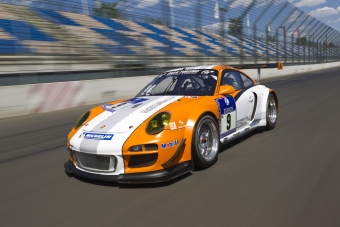
Porsche Announces 911 GT3 R Hybrid Racecar will run at the American Le Mans Series Finale Petit Le Mans October 2nd at Road Atlanta ATLANTA - Following the impressive performance at the Nurburgring 24-hour race where the Porsche 911 GT3 R Hybrid demonstrated the potential of its groundbreaking technology over 22 hours and 15 minutes, and led the overall classification for more than eight hours, the orange and white liveried 911 racer will now travel to the USA and Asia. Porsche has received an invitation to contest the season final of the American Le Mans Series, the race series featuring the world's fastest sport cars, at the 'Petit Le Mans' at Road Atlanta on October 2. The race runs over a distance of 1,000 miles or a maximum of ten hours. The Porsche 911 GT3 R Hybrid will not be eligible for points, as hybrid technology is not yet included in the GT regulations. |
|
|
|
For November 7, Porsche then plans to race the 911 GT3 R Hybrid at the season final of the new Le Mans International Cup, the six hour race in Zhuhai, China. Again here, the vehicle is not competing for points. "After the 911 GT3 R Hybrid's fantastic performance at the Nurburgring 24 Hours, we are now eager to gain more experience with the hybrid technology on a variety of race tracks," says Hartmut Kristen, Head of Porsche Motorsport. |
"At the same time, we would like to show fans and customers in our most important markets how our 'race lab' performs under racing conditions," adds Kristen.
The Porsche 911 GT3 R Hybrid, featuring two electric motors at the front axle each developing 60 kilowatts to supplement the 480 horsepower normally-aspirated rear-engine, expressly typifies the philosophy of "Porsche Intelligent Performance": Under braking, the 911 GT3 R Hybrid converts kinetic energy into electrical energy and stores it in a flywheel. During acceleration, this energy is automatically delivered to the front wheels, supporting the combustion engine. This leads to a reduction in fuel consumption and increases the cruising range. Moreover, drivers can manually utilize the stored energy with a boost-paddle on the steering wheel for overtaking.
Why Porsche Races
The connection between the Porsche 911 and racing is unlike any that exists in the world of sports cars. To Porsche, motorsports is a breeding ground, a mobile laboratory where engineering ideas are tested under the harsh light of competition. The lessons learned on the race track translate directly to Porsche sports car on the road. To see 911 race cars in action on the world's most challenging tracks is to witness Porsche working out the fundamental questions of performance engineering.
What innovations will make a 911 accelerate faster, stop quicker, steer with more accuracy and corner with higher levels of grip? What efficiencies are still to be achieved in the critical areas of fuel consumption? What technologies can be devised to surround the driver with the most advanced safety systems?
So while there are trophies to compete for, and championships to win, we race for a prize far more relevant: the evolution of real-world performance. One place you'll see Porsche proving its engineering theories on the track is in the American Le Mans Series (ALMS). Founded in 1999, ALMS is an endurance racing series that has established itself as a vital forum for developing new technologies and transferring them to the street. It has established itself as the most important race series for GT sports cars and prototypes in North America.
Porsche customer teams have more than 100 class wins in the ALMS. And for nine of the 11 years of ALMS' existence, Porsche has earned the GT/GT2 manufacturers title in the ALMS--all with the Porsche 911 GT3 R/RS/RSR family of race cars. Since the 2006 season, Porsche has also been lining up on the starting grid with a prototype in the LMP2 (Le Mans Prototype 2) class: the RS Spyder. In winning the LMP2 manufacturers', drivers' and team championships in 2006, Porsche made an impressive return to prototype racing.
Since 2008, more customer teams have taken their place on the starting grid in the RS Spyder, not only in the ALMS, but also in the European Le Mans Series (LMS) and the legendary Le Mans 24 Hour race. In 2010, RS Spyder continues to write Porsche's story of success in motorsport. With such a commitment to the proving grounds of motorsports, it's not far from the finish line to the Porsche assembly line. The race-ready street versions of the 911 like the GT3 RS are made within the same assembly facilities as all other 911 models.
Photo: Porsche
(July 21, 2010)