|
|
 |
 |
||||||||
|
Automotive Intelligence - the web for automotive professionals and car enthusiasts |
|||||||||
|
October 2013
© 1998 - 2013
Copyright & |
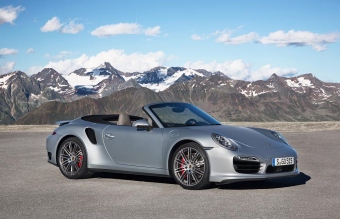
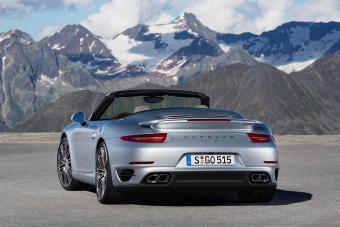
While the rear-axle steering has an immensely positive impact on handling for the two new super sportscars, both on the racetrack and during everyday use, the active aerodynamics can be tuned to offer optimum efficiency or driving dynamics at the touch of a button, depending on the driver's wishes. More than ever before, both of these new top-of-the-range models also make a clear visual statement about their performance. The characteristic, widely flared rear wings of the new 911 Turbo generation are 28 mm wider than those of the 911 Carrera 4 models – a virtually level surface of just over a hand's width extends out from the C-pillar to the outer edge of the vehicle. The impressive effect of this width is accentuated still further when the top is down. Another eye-catching feature of the 911 Turbo Cabriolet is the exclusive Porsche panel bow top with its lightweight magnesium frame. This innovative technology enables the Coupé-like arch to the roof to be achieved when the top is closed. This arch, which also offers advantages in terms of aerodynamics, is not feasible using conventional construction techniques. As with predecessor models, the roof opens and closes in around 13 seconds, at speeds of up to 50 km/h. Premium furnishings in the interior The interior of the new Cabriolet models follows that of the 911 Turbo Coupé. The S-model boasts a particularly extensive range of furnishings, with features including an exclusive interior in Black/Carrera Red and adaptive Sport Seat Plus seats with 18-way adjustment and memory. In addition, the backrest shells of the seats are leather trimmed with double cap seams, and various elements are achieved in a carbon look. As with the predecessor models, the Bose sound system is fitted as standard – and, for the first time, a Burmester system is also available on request. What's more, the radar-controlled adaptive Cruise Control system, camera-based road sign and speed limit recognition function and reversing camera are also available as options. The new top-of-the-range 911 Cabriolet models will be launched onto the market in December 2013. In Germany, the 911 Turbo Cabriolet costs EUR 174,431 and the new open-top 911 Turbo S EUR 207,989, inclusive of VAT and country-specific equipment in each case. 1) 911 Turbo and 911 Turbo S: urban fuel consumption: 13.2 litres/100 km; extra-urban fuel consumption: 7.7 litres/100 km; combined fuel consumption: 9.7 litres/100 km; CO2 emissions: 227 g/km. 2) 911 Turbo Cabriolet and 911 Turbo S Cabriolet: urban fuel consumption: 13.4 litres/100 km; extra-urban fuel consumption: 7.8 litres/100 km; combined fuel consumption: 9.9 litres/100 km; CO2 emissions: 231 g/km. Photos: Porsche (Sept. 26, 2013)
|
||||||||