|
|

|
||||
|
September 14, 2005
© 1998
- 2005 Copyright & |
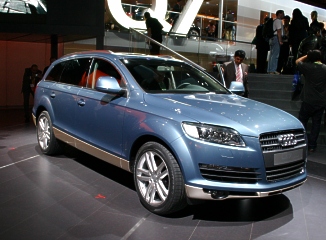
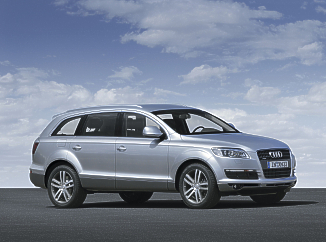
The Audi Q7 sets new trends through its design alone. Characteristic Audi styling is reflected in the broad curve of the roof and the distinctive high body surface in relation to the flat window area. The dynamic sweep of the front section and the powerful rear end with its sharply sloping D-posts fashion a coupe-like silhouette.
Equally typical of the current Audi design language are the shoulder line and dynamic line, which define the side section. The paintwork of two contrasting body colors creates a striking look and is standard on the Q7 V8 and optional on the V6 model. Seen from the front, the single-frame grille and the wide headlight units with visible light tubes behind clear-glass covers identify the Q7 as a latest-generation Audi model. The V-shape of the engine compartment lid sets a dynamic, pioneering trend in front design -- a clear indication of the power of each of the available engines. Typical for a vehicle with the genes of an off-roader are the high ground clearance of 7.9 inches or 200 millimetres (with steel-spring suspension) and the 18-inch wheels (up to 20-inch on request) in the striking, broad curve of the wheel arches. Off-road capability is also enhanced by a distinctly short overhang at the front and the sturdy underride protection at the front and rear. Clear architecture and ergonomic design, combined with the finest materials and excellent craftsmanship: these are the first and lasting impressions conveyed by the interior of Audi's first SUV. The feeling of generous spaciousness from every seat is due in no small measure to the colors chosen for the materials. Large surfaces in the same color and material dominate. In addition to aluminum and high-quality plastic, three different wood options are available for the horizontal trims in the instrument panel and doors. This ambience serves to reveal the vehicle's kinship with the Audi A6 and A8 sedans. The styling of the controls was clearly inspired by the interior of the A6, as was the driving area with teardrop-shaped frames for the instruments. The driver-integrating cockpit with the MMI multimedia interface impresses with the ergonomic qualities of Audi's current interior design. Broadly curved and encompassing the upper part of the center console, the controls and switches form a central operating and information unit designed with the driver in mind. Body and safety In contrast to earlier SUV generations that were based on a ladder-type chassis frame in the tradition of an all-terrain vehicle, the Audi Q7 has a self-supporting body of lightweight steel construction. The drag coefficient of only 0.34 is the best in its class and is evidence of the aerodynamic qualities of the lines. With regard to occupant safety, too, the body of the Audi Q7 provides a standard that lives up to the high claim of the brand. Zones of defined deformation in all sections direct the impact energy specifically away from the high-strength passenger cell which offers maximum survival space. In the event of a frontal collision, front sensors behind the radiator grille, in conjunction with other sensors and control units, register a crash within the space of a few thousandths of a second. A few milliseconds later, the belt tensioners are triggered to minimize any possible belt slack. A belt-force limiter yields at a particular load threshold to allow occupants to sink into the inflated airbag. The full-size front airbag functions in two stages: during the first stage -- when it ignites in low- speed accidents -- there is less load on the occupant. At higher speeds, the deployment of the second stage fully utilizes the protective potential of the front airbag. The Audi Q7 is also equipped as standard with side airbags at the front as well as the sideguard head-protection airbag system, which virtually covers the entire side window area up to the third seat row. Sensors in doors and C-pillars ensure reliable and fast deployment in the event of a side or oblique collision. The Audi Q7 also affords occupants excellent protection against the consequences of a rear-end collision. It already meets the requirements of future standards, i.e. it withstands an impact against a deformable barrier at 49.7 mph or 80 km/h and with 70 per cent overlap. Powertrain The Audi Q7 will be introduced in North America with a 4.2 liter 350 horsepower V8 FSI engine. This V8 is a close relative of the equally large power plant that will drive the most dynamic Audi in the near future, the RS 4. Like the RS 4 engine, the V8 in the Q7 has FSI direct injection, which -- following five victories in the Audi R8 Le Mans racing car -- is now being introduced in a production eight-cylinder model. FSI engines deliver more power and dynamism than the conventional power plant with manifold injection -- and they do so with outstanding fuel economy. With this remarkable achievement, Audi is opening up a new dimension in the efficiency of standard petrol engines, demonstrating once again the brand's proverbial "Vorsprung durch Technik." The V8 has been retuned for use in the Audi Q7. A fuller torque curve up to nominal speed and spontaneous response -- these are the characteristics of this new engine. The engine excels not only with its dominant power output (350 hp) at 6,800 rpm and a maximum torque of 324.5 lb. ft. at 3,500 rpm. The resultant driving performance is excellent, even in the face of tough competition. In just 7.4 seconds the new 4.2 quattro variant of the Audi SUV sprints from zero to 60 mph and accelerates superbly up to a top speed of 154 mph. (European times, North American times not yet available). The V8 will be joined by a 3.6 FSI V6 version in September which will generate 280 hp. New quattro generation A typical feature of all high-performance Audi vehicles is quattro permanent all-wheel drive -- a drive principle that is now celebrating 25 years of success in motor sport and standard production. More than two million Audi quattro models have left the assembly line so far -- a number that speaks for itself. quattro ensures excellent traction and lateral stability and minimizes the effect of propulsive power on the vehicle's self-steering properties. This is the prerequisite for high cornering speeds and a high degree of driving stability -- on and off-road. Hence, it was a given that the Audi Q7 would be a showcase for the company's most advanced development of quattro all-wheel drive. A Torsen differential in the new Audi Q7 -- with its longitudinally installed engines -- automatically ensures optimum power distribution to all four wheels. The name Torsen is a combination of the terms "torque" and "sensing." The Torsen differential is a self-locking worm gear. Like the RS 4 performance sedan, the Q7 is equipped with the latest- generation quattro drive technology. Here the torque split between front and rear axle is 40:60. This provides the basis for even more agility -- most notably when steering into bends -- with practically no perceivable torque steer. Together with direct servotronic steering -- standard in all versions -- this means that the driver enjoys a level of steering precision and clearly defined handling that up to now has been unimaginable in an SUV and which has only rarely been experienced in a sports car. (Sept. 12, 2005)
|
|||