|
|
 |
 |
||||||||
|
Automotive Intelligence - the web for automotive professionals and car enthusiasts |
|||||||||
|
June 28, 2012 This Week:
© 1998 - 2012
Copyright & |
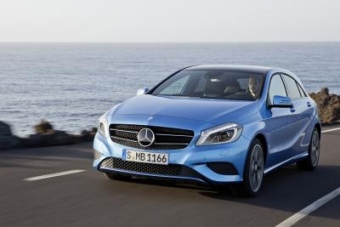
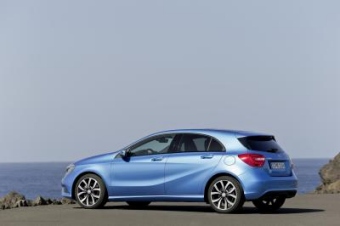
The fact that the new A-Class is a sporty hatchback model with a low centre of gravity is reflected in its dimensions: measuring 4292 x 1780 x 1433 mm (length x width x height), it hugs the road. Compared with its predecessor, which followed a different design, the height has been reduced by 160 millimetres.
The A-Class is a five-seater model. The rears seats provide room for three passengers, despite looking like two individual seats with their sporty design. The boot volume is 341 litres, based on the VDA standard. If the rear seat backrests are folded down, its capacity jumps to 1157 litres. In all models the seat backrests feature a 60:40 split can be folded forward individually. The width of the luggage compartment between the wheel housings is 1050 mm. A wide choice of petrol and diesel engines meets every power requirement and reaches new heights in terms of efficiency and environmental compatibility: the A 180 CDI will be the very first Mercedes-Benz to emit only 98 g of CO2 per kilometre. Moreover, the A 220 CDI (available from December 2012) already meets the Euro 6 emission standard which only comes into force in 2015. All engines of the new A-Class feature the ECO start/stop function as standard. The engines can be combined with the new six-speed manual transmission or optionally with the 7G-DCT dual clutch automatic transmission, which ideally combines comfort and sportiness. Fuel consumption down by up to 35 percent compared to comparable preceding models, accompanied by a considerable power increase: these are the salient features of the engine range for the new A-Class. "The new four-cylinder models from Mercedes-Benz occupy a leading position by virtue of their performance, high efficiency and very low emissions. They impress with their smooth, superior power delivery and offer customers refinement at the highest level," says Professor Dr Thomas Weber, Daimler Board Member responsible for Group Research and Mercedes-Benz Cars Development. Refined sportiness means maximum agility combined with the sense of safety, unspoilt driving stability and high levels of ride comfort which are all typical of the brand. The suspension of the new A-Class has a four-link rear axle, electromechanical power steering with assistance functions and ESP® with "Extended Traction Control" (XTC). During development, the suspension experts made intensive use of simulations and the driving simulators at the Mercedes development centre in Sindelfingen as part of the so-called digital ride and handling test. The preconditions for achieving dynamic handling are excellent in the A-Class. This is because compared with its predecessor the centre of gravity (24 mm lower) and seating position (174 mm lower) has been reduced significantly. A new feature is the four-link rear axle: forces are absorbed by three control arms and one trailing arm per wheel. This means that longitudinal and lateral dynamics are virtually independent of one another. Wheel carriers and spring links are made of aluminium to reduce the unsprung masses. The goal was to achieve high lateral agility with high driving stability thanks to small sideslip angle on the rear axle. Three chassis and suspension set-ups are available: the comfort suspension and optional sports suspension for sporty yet comfortable handling (in conjunction with the Dynamic Handling package or the AMG Sport equipment line). In addition, the A 250 Sport has a sporty, "engineered by AMG" high-performance suspension. Altogether this results in low dynamic rolling behaviour and low start-off pitch angle. Furthermore, the vehicle also has a reduced tendency to understeer in the higher lateral acceleration range: the driver is therefore able to control changes in direction with low steering input but high steering precision. When accelerating out of bends taken at speed, the tendency to understeer is reduced even further by "Extended Traction Control" (XTC): with this function, ESP®provides support in the form of directional stability by generating a yaw moment on the front and rear wheels located on the inside of the bend. Photos: MB (June 27, 2012)
|
||||||||