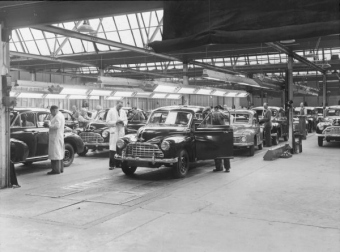
Final
inspection of Morris MO Oxfords, and MM Minors (1948 - 1952)
Oxford - MINI Plant
Oxford celebrates 100 years of car-making this March, against a
background of rising production, increased investment and continuing
expansion. Today, Plant Oxford employs 3700 associates who manufacture
up to 900 MINIs every day, and has contributed over 2.25 million MINIs
to the tally of over 11.65 million cars that the factory has produced
since 1913.
The first car built at the factory, a
Bullnose Morris Oxford, emerged on 28 March 1913 and has been followed
by cars from a wide range of famous British brands – and one Japanese -
including MG, Wolseley, Riley, Austin, Austin Healey, Mini, Vanden Plas,
Princess, Triumph, Rover, Sterling and Honda, besides founding marque
Morris and MINI.
The Pressed Steel
Company subsidiary occupying the same Cowley complex
also built bodyshells for Rolls-Royce, Bentley,
Jaguar, MG, Standard-Triumph, Ford and Hillman, as
well as tooling dies for Alfa Romeo. The plant has a
long and impressive history of shipping cars abroad
that has resulted in more than1.7 million MINIs
going to overseas customers.
The plant has produced
an array of famous cars, including the Bullnose
Morris, the Morris Minor, the Mini, India’s
Hindustan Ambassador and today’s MINI. It also
produced Hondas for a short period in the ‘80s, as
well as some slightly notorious models including the
early Riley Pathfinder, the much-derided Morris
Marina, the startling ’70s wedge that was the
Princess and in the Austin Maestro one of the
world’s earliest ‘talking’ cars.
There have been eight
custodians of Plant Oxford over the past 100 years,
beginning with founder William Morris who owned the
factory both directly and through Morris Motors
until 1952, when Morris merged with arch-rival
Austin to form the British Motor Corporation. Morris
himself, by this time known as Lord Nuffield, was
chairman for six months before retiring. During the
early ‘60s the plant had as many as 28,000 employees
producing an extraordinary variety of models.
In 1967 BMC became
British Motor Holdings after merging with Jaguar,
and the following year that group was merged with
the Leyland truck company (which also included
Triumph and Rover) to form the British Leyland Motor
Corporation. Nationalisation followed in 1974, the
group undergoing several renamings until it became
the Rover Group in 1986. Boss Graham Day was charged
with privatising the company for the Thatcher
government, which was completed in 1988 with the
sale to British Aerospace. They in turn would sell
the Group, which included Land Rover, to BMW in
1994.
BMW Group invested
heavily in Rover, deciding early on that a
replacement for the Mini would be a priority. But
considerable headwinds, and an unfavourable exchange
rate lead to BMW selling Rover to the Phoenix
Consortium in 2000 and Land Rover to Ford in 2000.
The MINI brand was retained together with Plant
Oxford, as Cowley had been renamed, along with the
associated Swindon pressings factory and the new
Hams Hall engine plant in Birmingham that was
preparing for production.
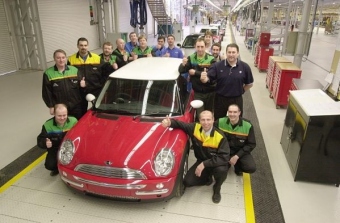
Today, Plant Oxford is
flourishing with the manufacture of the MINI
hatchback, Convertible, Clubman, Clubvan, Roadster
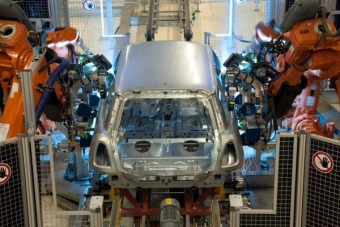
and Coupé. It is currently undergoing a major
investment that includes the installation of a 1000
new robots for both a new body shop and the existing
facility. This represents the lion’s share of a
£750m investment programme, announced in the last
year, which also sees the significant upgrading and
installation of new facilities at the company’s Hams
Hall engine plant and the Swindon body pressings
factory.
The Oxford plant has
generated considerable wealth for the nation, as
well as for many other countries around the world
during its 100 years, providing direct employment
for hundreds of thousands of employees and tens of
thousands more through indirect jobs. The plant has
a long history of export success, Morris products
accounting for nearly 30 percent of the nation’s
total exports by the mid 1930s. In 1950, the plant
produced its 100,000th overseas model – a Morris
Minor – and by 1962 BMC was shipping 320,000
examples of its annual production of 850,000
vehicles to over 170 countries, Oxford contributing
a major part of that total. BMC was the UK’s biggest
exporter in the early ‘60s, just as Morris had been
in the ‘30s.
Plant Oxford has
contributed to the industrial activities of a
surprising number of far-flung countries too, by
producing tens of thousands of cars for export in
CKD (Completely Knocked Down) form for assembly in
overseas factories. Countries that have built cars
from kits include Argentina, Australia, Belgium,
Cuba, East Africa, Ghana, Holland, Hong Kong, India,
Indonesia, Iran, Ireland, Italy, New Zealand,
Malaya, Mexico, Nigeria, Spain, Sri Lanka, Tanzania,
Trinidad, Turkey, Uganda, Uruguay and many others.
By 1967 CKD cars formed 40 percent of BMC’s exports,
the kits assembled in 21 plants around the world.
Morris Oxfords, Minors, MGAs, Minis, Morris 1100s
and commercial vehicles were among the many models
built in these distant factories. Plant Oxford’s
export record is equally impressive today, no less
than 1.7 million MINIs having been exported to over
100 countries since 2001.
Today, Plant Oxford
forms the central element of BMW Group’s UK
production network, which includes the Hams Hall
engine factory in Birmingham and the Swindon
pressings plant, formerly a part of Pressed Steel.
The network faces a bright future as the next
generation MINI family enters production over the
coming years amid a trend of rising sales and
exports.
The Cars Many famous
cars have been produced at Plant Oxford, several of
them revolutionary. Here are some highlights:
‘Bullnose’ Morris
Oxford 1913-26 : William Morris’s first car,
actually named the Morris Oxford but known as the
Bullnose because of its distinctive, rounded
radiator cowling in brass. A bold series of price
cuts saw Morris becoming the UK’s biggest selling
marque by 1924.
Morris Minor
1928-32 : A small, affordable car whose price
Morris eventually cut to £100, ensuring considerable
popularity. Together with the baby Austin Seven, it
made the motor car significantly more attainable in
Britain.
Morris Eight
1935-48 : A big pre-war and post-war hit, this
barrel-bodied Morris developed through several
iterations and remained a common sight right into
the ‘60s.
Morris Minor
1948-71 : A major step ahead in handling,
steering, braking and roominess, the Alec
Issigonis-designed Minor was a huge success. The
Minor was the first British car to sell over a
million, a milestone celebrated with a limited run
of Minor Millions painted in a dubious shade of
lilac. It was sold as a saloon, a semi-timbered
Traveller estate, a convertible, a van and a
pick-up.
Morris Oxford III
1956-58 : The ‘50s Oxford was a family car
staple of the Morris range, besides continuing with
the model name that had started Morris off. An
unremarkable car, except that it was the basis of
India’s once hugely-popular Hindustan Ambassador,
Morris shipping all the Oxford III tooling to the
company in 1957. The Ambassador – or Amby, as it is
fondly known – remains in small-scale production
today.
BMC Mini 1959-69 :
The revolutionary Mini was another creation from
Alec Issigonis, its transverse, front-wheel drive
powertrain and space-efficient packaging redefining
small car design. Go-kart handling soon inspired the
sportier Coopers and giant-slaying, headline-making
competition performances. Classless, fashionable,
much-loved and widely exported, it introduced a word
to the English language and became Britain’s most
famous – and most produced - car. Plant Oxford
manufactured it for 10 years from 1959, its
counterpart Longbridge, Birmingham factory remaining
the chief UK source until its demise in 2000.
BMC 1100/1300
1962-74 : The second front-drive Issigonis
model, essentially an enlarged Mini with Pininfarina
styling and Hydrolastic fluid suspension. The most
advanced small family car on sale at the time, it
sold even faster than the Mini to become Britain’s
best-seller for 10 years. Launched as a Morris, it
was also sold as an Austin, MG, Riley, Vanden Plas
and a Wolseley, and was offered in two-door,
four-door and estate bodystyles.
Morris Marina
1971-80 : Much derided at the time, but the Ford
Cortina-bashing Marina was a top five best-seller
for years despite its simple mechanicals, and a
mainstay of the plant through the 1970s. Unusual for
offering a coupe version that was cheaper than the
saloon, it was replaced by the lightly restyled Ital
in 1980, this car destined to be the last Morris.
Like the Minor it replaced, the Marina achieved
sales of over one million.
Triumph Acclaim
1981-84: Essentially a rebadged Honda Civic, the
Acclaim was a stop-gap model that was the product of
an unusual deal struck in 1979 by BL Cars and Honda.
The goal was to providing BL with a new model
offering between the 1980 launch of the Austin
miniMetro and 1983’s Austin Maestro, the Acclaim’s
Honda-designed production lines also prompting the
installation of the first robots at the Oxford
plant. The Acclaim was also significant for being
the first Japanese car to be built in the UK, and
the last Triumph. The BL-Honda partnership
eventually led to the Japanese company setting up
its own UK factory at Swindon.
Rover 800
1986-9/Honda Legend 1986-8: These executive cars
were unusual for being the progeny of an engineering
collaboration between Rover and Honda, the two
sharing inner bodywork, suspensions and some
drivetrains while presenting unique body and
interior designs. Plant Oxford not only built the
Rover 800 but for a short period, the sister Honda
Legend model too. The 800 was also part of a major
export initiative to the US in the mid ‘80s, under
the Sterling brand name. This much deeper
collaboration furthered a fruitful period in which
Japanese just-in-time and continuous improvement
techniques were introduced to the plant, eventually
leading to significant gains in vehicle build
quality.
Rover 75 1999-2000 The
first and only Rover wholly developed under BMW
ownership, the elegantly styled 75 saw a wholesale
improvement in both quality and dynamic standards
for the brand. Production transferred to Longbridge,
Birmingham, after BMW sold Rover in 2000 and ended
prematurely in 2005, although variations of the
model live on in China as Roewes and MGs.
MINI 2001-06:
The all-new MINI recalibrated the Mini as a larger,
vastly more sophisticated premium supermini in an
evolution that defined a new market, just as the
original car did. Widely praised for styling that
honoured its predecessor with contemporary and
hugely appealing flair, it also won plaudits for its
handling, imaginative interior design and build
quality. The MINI also introduced personalisation on
a scale never before seen in a small car, firing the
gun on a trend now widely copied. It exceeded its
sales targets from the start – unlike the classic
Mini – and was joined by a Convertible in 2002.
MINI 2006 to date :The
next generation MINI hatch further refined the 2001
concept with more space, more sophistication, more
advanced engines – now mainly UK-built – more
equipment and more choice. This was expanded
considerably by the introduction of the Clubman
estate in 2007, the Coupé and Roadster in 2012 and
the Clubvan in the same year. A renewed version of
the highly popular Convertible appeared in 2007.